

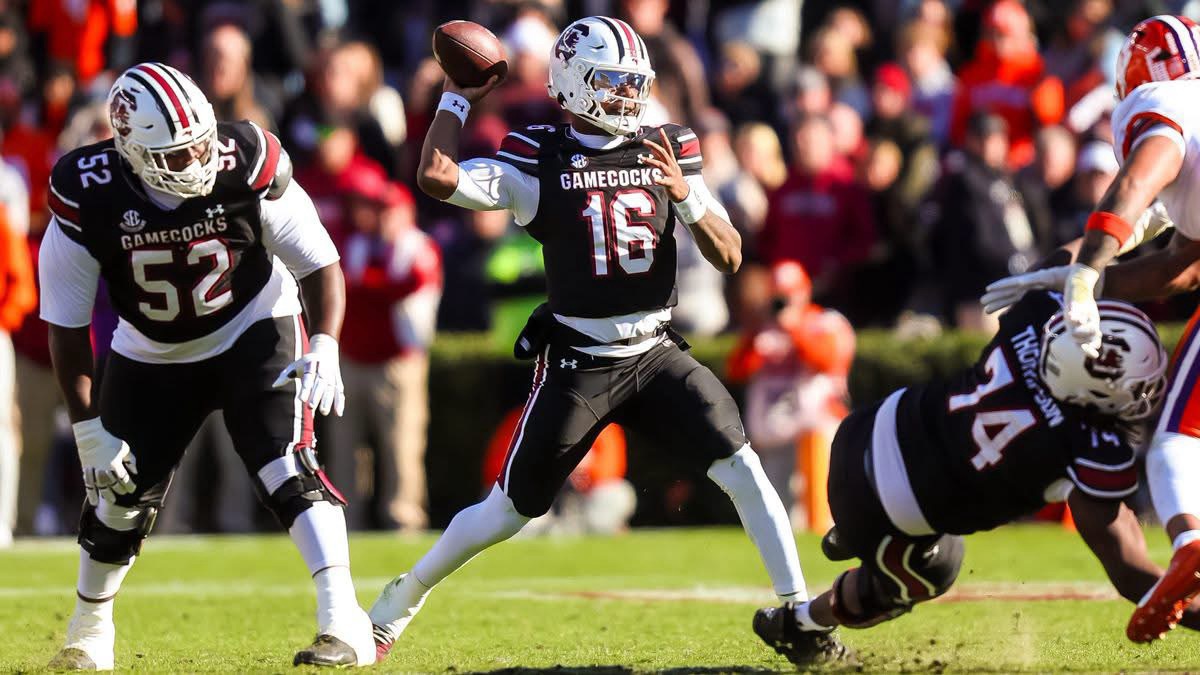
Gamecock fans are losing their minds over some of these latest Top 100 college football player rankings because LaNorris Sellers isn’t on them.
And for once, I don’t blame them.
I’ve seen lists with quarterbacks ranked ahead of Sellers that the average college football fan couldn’t pick out of a lineup.
But my problem isn’t really about South Carolina. It’s about what passes for “player evaluation” these days.
A lot of the people producing these rankings aren’t evaluating football players. They’re evaluating statistics.
There’s a difference.
You can pull up completion percentages, passing efficiency, yards per attempt, EPA, touchdown-to-interception ratios and whatever other analytics you want. Those numbers have value. I’m not anti-analytics.
But statistics tell you what happened.
Evaluation is supposed to help you understand why it happened — and what the athlete is capable of doing next.
I’ve evaluated football players for decades. I’ve trained them. I’ve studied biomechanics. I’ve measured athletes through speed, agility, change of direction, explosiveness and power. I developed my own AMP — Agility, Motion and Power — evaluation system years ago because I wanted to understand what made an athlete physically capable of playing at another level.
So when I evaluate a quarterback, I’m not just looking at his stat line.
I’m looking at his feet.
I’m looking at his hips.
I’m looking at his ability to generate torque.
I’m looking at how the kinetic chain works from the ground through the lower body, through the trunk, through the shoulder and ultimately through the football.
I’m watching how efficiently he transfers force.
I’m watching his release.
I’m watching his movement patterns.
I’m watching what happens mechanically when the pocket collapses and he can no longer operate under perfect conditions.
I’m watching the damn athlete.
And if you use your eyes and understand what you’re looking at, LaNorris Sellers jumps off the screen.
Is he a finished quarterback?
No.
Was everything perfect last season?
No.
But we’re talking about ranking the best players in college football, and raw talent has to be part of that equation.
Sellers possesses physical tools that very few quarterbacks in America have.
His combination of size, arm strength, mobility, power and athleticism is rare. More importantly, some of those characteristics aren’t things you’re going to manufacture in a quarterback room. You can improve mechanics. You can improve recognition. You can improve timing and decision-making.
You can’t coach somebody into possessing elite physical traits.
That’s where these rankings lose me.
Too many of them have become spreadsheets disguised as scouting reports.
The computer sees a quarterback who threw for more yards or had a better efficiency rating and spits him out ahead of Sellers.
My eyes tell me something different.
My experience evaluating athletes tells me something different.
And biomechanics damn sure tells me something different.
If you’re putting together a list of the Top 100 performances from last season, fine. Leave Sellers off if your criteria says he doesn’t belong.
But don’t call it a ranking of the Top 100 players in college football.
Because those aren’t the same thing.
Player evaluation requires projection. It requires understanding physical traits. It requires recognizing movement efficiency, athletic ceiling and how an athlete’s individual components fit together.
Most importantly, occasionally it requires closing the laptop and watching the football player.
LaNorris Sellers is one of the most physically gifted quarterbacks in college football.
You can debate exactly where he belongs in the Top 100.
But if you give me 100 college football players and tell me Sellers isn’t one of them?
Throw the damn list away.
Because at that point, you’re not evaluating football players.
You’re evaluating spreadsheets.
— JB