
By Jim Baxter | JB Talking Sportz
There are times when I find myself missing the college football I grew up watching. Not necessarily because the athletes were better or the games were more competitive, but because there was something about the sport back then that seems increasingly difficult to find today.
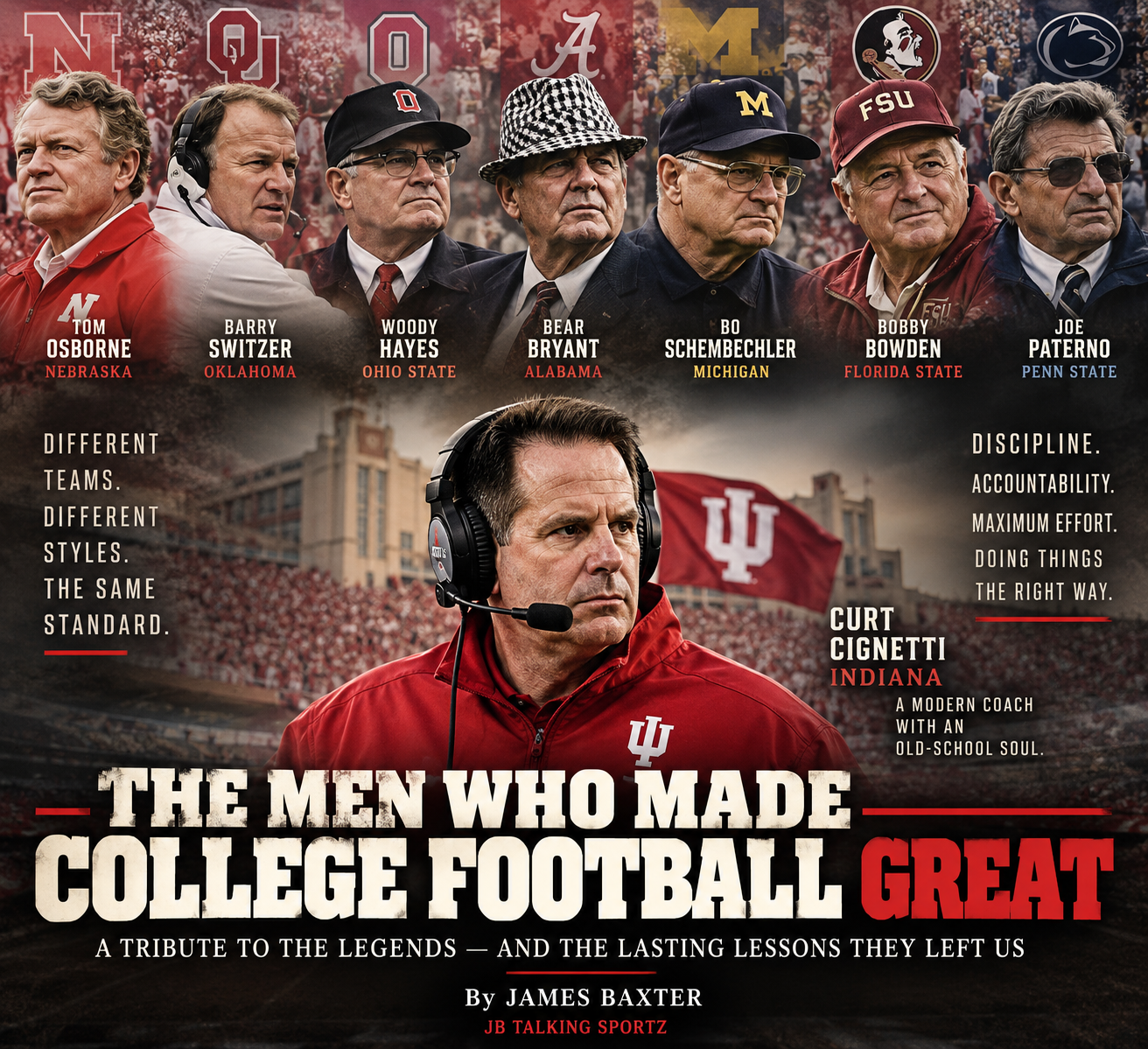
I miss watching Tom Osborne roam the sidelines at Nebraska. I miss Barry Switzer standing confidently on the Oklahoma sideline, knowing his Sooners were about to run the football right down somebody’s throat. I miss Woody Hayes at Ohio State, Bo Schembechler at Michigan, and Bobby Bowden building something extraordinary at Florida State.
I miss Bear Bryant leaning against that goalpost in his houndstooth hat. I miss Vince Dooley at Georgia and the unmistakable presence of Joe Paterno at Penn State.
Those were great times, and those men were great football coaches.
They weren’t perfect men, and I’m certainly not suggesting everything about college football was better in those days. But there was something fundamentally different about the way those coaches approached the game.
They didn’t simply build football teams. They built football programs.
And there is a tremendous difference between the two.
When you watched Nebraska play under Osborne, you knew exactly what was coming. Those massive offensive linemen were going to come off the football, the quarterback was going to execute that option offense, and Nebraska was going to test your physical and mental toughness for four quarters.
The remarkable thing was that everybody knew what Nebraska was going to do, and very few could stop it.
The same could be said about Switzer’s Oklahoma teams. The wishbone wasn’t some complicated offensive mystery. It was an exercise in discipline, execution, and forcing the opponent to defend every assignment on every play.
Miss one assignment, and Oklahoma could turn it into six points.
Hayes believed in physical football. Schembechler believed in discipline and toughness. Bowden understood how to combine exceptional athletes with an aggressive, confident approach to the game.
And Bryant? Well, Bryant understood something that every great coach eventually learns.
You don’t build champions by accepting anything less than a player’s best effort.
What made these men special wasn’t simply their understanding of X’s and O’s. There have been thousands of coaches who could draw up brilliant plays on a chalkboard.
What separated the great ones was their ability to establish a standard and convince an entire football program that the standard was nonnegotiable.
You practiced the right way. You prepared the right way. You played the right way.
And if you didn’t, somebody else would.
It wasn’t always pretty, and it certainly wasn’t always pleasant. But those coaches understood that football was a game of discipline, accountability, preparation, and execution.
Talent was important, but talent without discipline was wasted potential.
Which brings me to Nick Saban.
I believe Saban was one of the last great representatives of that old-school philosophy, even though he coached in a completely different era from many of those men.
Saban’s famous Process wasn’t some revolutionary concept. It was a modern interpretation of the same principles Osborne, Bryant, Hayes, and the others had preached for decades.
Don’t become obsessed with the scoreboard. Become obsessed with doing your job correctly.
Execute your assignment. Pay attention to details. Give maximum effort. Prepare yourself mentally and physically. Hold yourself accountable.
Do those things consistently, and the scoreboard will usually take care of itself.
That philosophy helped Saban build one of the greatest dynasties college football has ever witnessed.
And now, as I watch Curt Cignetti at Indiana, I find myself seeing something remarkably familiar.
I see an old-school football coach operating in a modern college football environment.
Cignetti is an outstanding X’s and O’s coach. Make no mistake about that. His understanding of football is exceptional, and his ability to prepare a team for an opponent is evident every Saturday.
But I don’t believe that’s what makes him special.
I believe it’s his relentless demand for maximum effort, discipline, accountability, and doing things the right way.
Sound familiar?
It should.
That’s what Saban demanded. That’s what Osborne demanded. That’s what Bryant demanded.
And it’s what Cignetti demands today.
Consider what he’s accomplished at Indiana. We’re talking about a program that spent generations being considered an afterthought in the Big Ten. A program where simply becoming bowl eligible was once considered a successful season.
Cignetti didn’t arrive in Bloomington accepting that Indiana was supposed to be inferior to Ohio State, Michigan, or Penn State.
He arrived expecting to win.
And then he convinced his players to expect the same thing.
That’s leadership.
Indiana’s remarkable rise to a national championship wasn’t simply the result of assembling talented football players. It was the result of establishing a culture in which expectations changed almost overnight.
I think that’s one of the most impressive coaching accomplishments I’ve witnessed in modern college football.
And perhaps what makes it even more remarkable is the era in which he’s doing it.
Today’s college football landscape is almost unrecognizable compared with the sport we watched forty years ago.
The transfer portal has turned roster management into a year-round exercise. NIL has introduced financial considerations that previous generations of coaches never had to navigate. Conference realignment has destroyed traditional rivalries and geographic identities that helped make college football special.
And somewhere along the way, I believe we’ve placed far too much emphasis on acquiring talent and not nearly enough on developing it.
Don’t misunderstand me. Players deserve opportunities, and I’m not suggesting they should be denied the ability to benefit financially from their talents.
But there is a difference between assembling a collection of talented individuals and building a football team.
A tremendous difference.
You can have five-star athletes at every position and still be a mediocre football team if those players aren’t committed to a common purpose.
You can have the most sophisticated offensive system in America, but if your offensive linemen don’t execute their assignments, it doesn’t mean a damn thing.
You can recruit the fastest receivers in the country, but speed means very little if they can’t catch the football or run the correct routes.
And you can have a defense loaded with future NFL players, but if those players aren’t disciplined enough to maintain their assignments, somebody is going to exploit them.
That’s football.
It was football in 1975, and it’s football in 2026.
The fundamentals haven’t changed nearly as much as people would have you believe.
I think one of the greatest things a coach can accomplish is creating an environment where players begin holding themselves accountable.
Not because they’re afraid of being punished.
Not because somebody is screaming at them.
But because they’ve developed enough pride in themselves, their teammates, and their program that anything less than maximum effort becomes unacceptable.
That’s when you know you’ve built something special.
And I believe that’s exactly what Cignetti has accomplished at Indiana.
There’s another quality I admire about him.
He doesn’t appear particularly interested in telling people what they want to hear. He doesn’t seem concerned about being the most popular personality in college football.
He’s interested in winning football games, and he understands what it takes to accomplish that.
I find that refreshing.
Maybe it’s because I grew up in an era when coaches were larger-than-life figures who represented something much bigger than themselves.
When you thought about Nebraska, you thought about Tom Osborne.
When you thought about Oklahoma, you thought about Barry Switzer.
Florida State was Bobby Bowden. Alabama was Bear Bryant. Michigan was Bo Schembechler.
Those men became synonymous with their programs because they established identities that endured for decades.
You knew what their teams stood for.
You knew what kind of football they were going to play.
And you knew they weren’t going to apologize for it.
Today, I sometimes wonder whether college football has become so obsessed with money, television contracts, recruiting rankings, and individual recognition that we’ve forgotten what made the game so special in the first place.
I miss those Saturday afternoons when Keith Jackson’s voice came through the television and you knew you were about to witness something memorable.
I miss the great rivalries, the marching bands, and the anticipation of watching two legendary coaches match wits for sixty minutes.
I miss watching teams that had developed an identity over years of recruiting, teaching, and building.
Most of all, I miss the men who made those programs what they were.
I realize nostalgia has a way of making yesterday seem better than today. And I recognize that some of those old-school coaching methods would have no place in today’s game.
But discipline never goes out of style.
Accountability never becomes obsolete.
Maximum effort never becomes outdated.
And doing things the right way will never stop being important.
That’s why I enjoy watching Curt Cignetti.
He reminds me that despite everything that has changed about college football, the fundamental principles of building a championship program remain remarkably consistent.
He reminds me of Osborne, Switzer, Bowden, Bryant, Hayes, Schembechler, and Saban.
Not because he coaches exactly like any of them, but because he seems to understand what they understood.
Great football programs aren’t built on talent alone. They’re built on standards, discipline, accountability, and a commitment to excellence that never changes.
Those old coaches understood that winning wasn’t something you simply hoped would happen on Saturday afternoon.
It was something you earned Monday through Friday.
And perhaps that’s what I miss most about those days.
Not just the football.
But the men who taught us what great football was supposed to look like.
I’m glad Curt Cignetti is around to remind us.
Because while college football has changed dramatically, the formula for greatness hasn’t changed nearly as much as we think.
And I, for one, hope it never does.
Jim Baxter
JB Talking Sportz
JBTalkinSportz.com