
North Carolina will arrive in Death Valley with a 2-0 record, an experienced quarterback, an improving defense and absolutely no reason to fear Clemson’s offense.
That last part may be the most important.
Clemson defeated Georgia Southern 22-7, but the Tigers still haven’t shown that they can consistently move the football or finish drives. Now Christopher Vizzina is expected to miss the game with an injury to his non-throwing elbow, leaving freshman Tait Reynolds to make his first career start.
North Carolina knows exactly what that means.
Bill Belichick will try to confuse Reynolds, attack Clemson’s protection and force the freshman to beat a defense that has allowed only one touchdown through two games.
This is no longer a game Clemson can take for granted.
The Belichick Factor
North Carolina finished 4-8 during Bill Belichick’s first season, but the Tar Heels already look more organized and much more difficult to beat in Year Two.
They opened the season with a 15-10 victory over TCU in Ireland, holding the Horned Frogs scoreless over the final three quarters. North Carolina followed that with a 35-3 win over East Tennessee State.
The level of competition must be considered, but allowing 13 points through two games still gets my attention.
This North Carolina team is not dominating every statistical category. What it has done is prevent opponents from finishing drives.
TCU reached the North Carolina 10-yard line twice during the second half and came away with nothing. ETSU reached the red zone once and failed to score.
That is classic Belichick football: make the opponent execute, tighten the coverage near the goal line and force the quarterback to make good decisions when the field becomes compressed.
The Man Running the Offense
Billy Edwards Jr. gives North Carolina an experienced quarterback who has played a lot of major college football.
Through two games, Edwards has completed 31 of 48 passes for 476 yards, two touchdowns and no interceptions. He threw for 232 yards in the win over TCU before completing 15 of 20 passes for 244 yards and two touchdowns against ETSU.
Edwards is not going to overwhelm Clemson with pure arm talent, but he is experienced, composed and willing to distribute the ball.
That may be exactly what North Carolina needs against Clemson’s defense.
Edwards cannot hold the football and wait for receivers to uncover. Clemson’s defensive front is still the strength of the team and will create pressure if given enough time.
North Carolina must use quick throws, screens and misdirection to keep Clemson from turning the game into a pass-rush competition.
Bobby Petrino Changes the Equation
North Carolina hired Bobby Petrino to repair an offense that averaged only 19.3 points and fewer than 290 yards per game last season.
Petrino has always been one of the better offensive designers in college football. His offense uses formations, motion, play-action and running back involvement to create favorable matchups.
North Carolina is averaging 25 points and 374.5 yards through two games. Those are not overwhelming numbers, but the Tar Heels are averaging 6.8 yards per play.
They are also taking care of the football through the air. Neither Edwards nor backup Miles O’Neill has thrown an interception.
Petrino will understand that his offensive line cannot allow Clemson’s defensive front to control the game. Expect North Carolina to move the pocket, use the screen game and give Edwards throws that can be completed before the rush arrives.
Clemson Must Find Jelani Thurman
Tight end Jelani Thurman has become Edwards’ most dangerous target.
Thurman leads North Carolina with eight receptions for 165 yards and a touchdown. He caught a 24-yard touchdown against ETSU and finished the game with 71 receiving yards.
At his size, Thurman creates matchup problems in the middle of the field. He can work against linebackers, position himself between zones and give Edwards a large target on third down and in the red zone.
Clemson cannot allow him to release freely off the line.
The Tigers must disrupt his route timing and make Edwards throw the ball toward the outside. If Thurman begins controlling the seams, North Carolina will be able to stay ahead of the chains and neutralize Clemson’s pass rush.
A Running Back Committee
North Carolina has not built its offense around one featured running back.
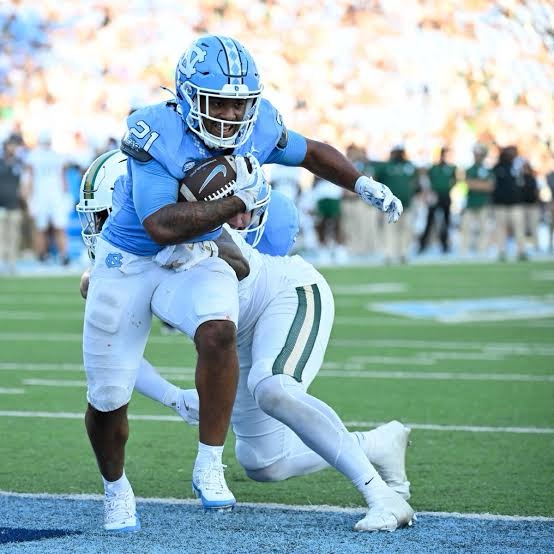
Benjamin Hall leads the Tar Heels with 85 yards on 15 carries. Demon June scored three rushing touchdowns against ETSU, while Jaylen McGill has provided additional production.
Against ETSU, North Carolina rushed for 161 yards on 27 attempts and averaged six yards per carry.
Hall is also a receiving threat. He caught a 26-yard touchdown on a screen against ETSU, giving Petrino another way to punish an aggressive defense.
Clemson’s linebackers must read their keys and avoid overrunning the football. Petrino will use Clemson’s pursuit against it if the Tigers become too aggressive.
North Carolina’s Defensive Identity
North Carolina has allowed only 268 yards and 6.5 points per game.
The Tar Heels are especially strong near the line of scrimmage. They have produced seven sacks through two games and held opponents to only 2.5 yards per rushing attempt.
Defensive linemen Xavier Lewis and Jaylen Harvey combined for four sacks against ETSU. Lewis now has four sacks through two games.
That is a major concern for a Clemson offense starting a freshman quarterback behind a line that has already struggled with missed assignments and negative plays.
North Carolina will not need an exotic game plan. The Tar Heels can attack Clemson’s protection, crowd the running lanes and make Reynolds prove he can consistently complete passes under pressure.
Where Clemson Can Attack
North Carolina’s defensive numbers are impressive, but there is a significant weakness hiding underneath them.
Opponents have converted nearly 47 percent of their third downs.
That ranks among the worst rates in the country and tells me the Tar Heels have struggled to get off the field despite limiting points.
Opposing quarterbacks have also completed more than 67 percent of their passes. Most of those throws have been underneath—the Tar Heels have allowed 353 passing yards but no passing touchdowns—but the completions are available.
Clemson must be patient.
Reynolds does not need to hit a 60-yard touchdown on every possession. He needs to complete the easy throws, keep Clemson out of third-and-long and allow his playmakers to create yards after the catch.
The Tigers can move the football against this defense. The question is whether they can finish drives without making the mistake that changes the game.
The Freshman Quarterback Test
Tait Reynolds completed 16 of 27 passes for 178 yards after replacing Vizzina against Georgia Southern. He has completed 20 of 33 attempts this season without an interception, but he has yet to throw his first college touchdown pass.
He also lost a fumble against Georgia Southern.
Reynolds has shown some ability to improvise, but Clemson’s offense has produced too many punts and field goals with him behind center. Now he must make his first start against a defense coached by Bill Belichick.
That is quite an introduction to college football.
North Carolina will disguise pressure, change its coverage after the snap and attempt to make Reynolds hesitate. Clemson must simplify the picture for him with motion, quick throws and a dependable running game.
The worst thing the Tigers can do is place the entire offense on the freshman’s shoulders.
The Matchup That Concerns Me
Xavier Lewis and North Carolina’s defensive front against Clemson’s offensive line is the matchup that should concern every Clemson fan.
Lewis has four sacks through two games. Clemson has struggled to protect its quarterbacks and has allowed too many defenders into the backfield.
If North Carolina begins winning with four rushers, Belichick can drop seven defenders into coverage and make Reynolds work through crowded throwing lanes.
Clemson cannot allow that to happen.
The offensive line must give Reynolds enough time to make his first read, and the running backs must recognize pressure when North Carolina brings additional defenders.
The Matchup Clemson Must Win
Clemson’s defensive front must control North Carolina’s offensive line.
The Tigers cannot allow Petrino to establish the running game and keep Edwards in comfortable down-and-distance situations.
If North Carolina is consistently facing second-and-five, Petrino can use his entire playbook. That opens the door for play-action, screens, tight end routes and quarterback movement.
Clemson needs to create second-and-long and force Edwards to hold the football. That is when the Tigers’ pass rush can take over.
Five Tar Heels to Know
Billy Edwards Jr., quarterback: An experienced and efficient quarterback with 476 passing yards and no interceptions.
Jelani Thurman, tight end: North Carolina’s leading receiver and Edwards’ most dangerous matchup weapon.
Benjamin Hall, running back: The team’s leading rusher who can also hurt Clemson in the screen game.
Demon June, running back: North Carolina’s short-yardage and scoring threat after producing three touchdowns against ETSU.
Xavier Lewis, defensive lineman: The most dangerous player on North Carolina’s defensive front with four sacks through two games.
Five Things Clemson Must Do
1. Protect Tait Reynolds.
The freshman cannot spend his first start running for his life.
2. Establish the running game.
Clemson must take pressure off Reynolds and prevent North Carolina from dictating every passing situation.
3. Find Jelani Thurman on every snap.
The Tar Heels will use their tight end to attack the middle of Clemson’s defense.
4. Finish drives.
Field goals may not be enough. Clemson must turn red-zone opportunities into touchdowns.
5. Avoid the catastrophic mistake.
A turnover that gives North Carolina a short field could completely change this game.
JB’s Early Read
North Carolina may not be a great football team, but the Tar Heels are 2-0, confident and built to exploit Clemson’s current weaknesses.
They can pressure the quarterback. They have been difficult to run against. They protect the football through the air, and they have an experienced quarterback facing a freshman making his first start.
Clemson still has the more talented roster and will be playing in Death Valley. The Tigers should win this game.
But “should” has become a dangerous word around Clemson football.
If the Tigers continue struggling to protect the quarterback, converting drives into field goals and committing careless turnovers, North Carolina can absolutely win this game.
The Tar Heels are not coming to Death Valley to participate in Clemson’s recovery.
They are coming to make the crisis worse.