

STOCK RISING
1. SAM LEAVITT | QB | LSU
STOCK: RISING
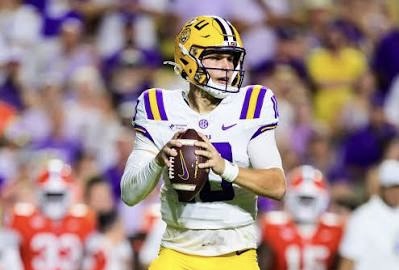
Sam Leavitt delivered the kind of performance Saturday that can change the conversation surrounding a quarterback prospect.
Against Mississippi State, Leavitt completed 31 of 38 passes for 289 yards, four touchdowns, and no interceptions in LSU’s 31-0 victory.
That’s an 81.6 percent completion rate.
But what impressed me wasn’t necessarily the completion percentage.
It was the decision-making.
Leavitt has struggled with turnovers this season, and that’s something that has concerned me when evaluating his NFL potential.
However, against Mississippi State, he demonstrated better command of the offense and made more efficient decisions with the football.
That’s what I want to see.
One outstanding performance doesn’t erase the previous six games, but it can demonstrate that a quarterback is learning and developing.
And development is something I place considerable emphasis on.
My TAKE: Leavitt helped himself considerably this weekend. I’m not ready to move him into the elite quarterback category, but he’s heading in the right direction.
2. DREW MESTEMAKER | QB | OKLAHOMA STATE
STOCK: RISING
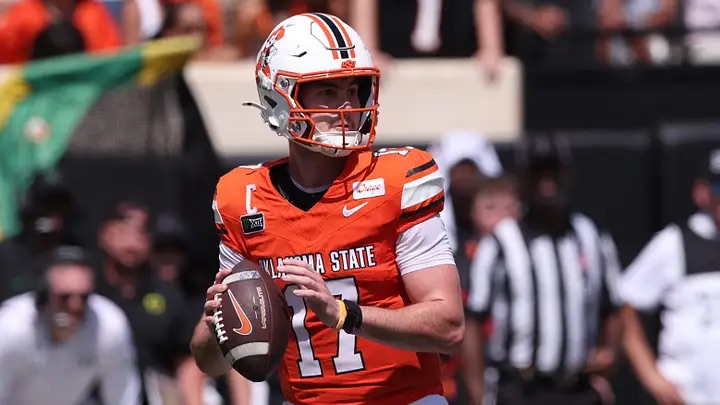
I’ve become increasingly intrigued with Drew Mestemaker.
The Oklahoma State quarterback continues to demonstrate impressive arm talent and the ability to generate explosive plays.
Against Houston, Mestemaker completed 22 of 34 passes for 365 yards and three touchdowns in a 35-32 loss.
And yes, he threw an interception.
But here’s where evaluating the quarterback rather than the final score becomes important.
Mestemaker continues to show the ability to push the football downfield and create opportunities in the passing game.
What interests me is his unconventional development.
He wasn’t one of those celebrated five-star quarterback prospects coming out of high school.
He had to earn his opportunity.
And sometimes those players develop an understanding of the game that highly recruited prospects never acquire.
I like his arm talent, his confidence, and his willingness to challenge defenses.
However, I still want to see how consistently he processes information against complicated defensive schemes.
There is a significant difference between identifying an open receiver and anticipating where that receiver will become open.
That’s one of the things that separates college quarterbacks from NFL quarterbacks.
MY TAKE: Mestemaker is climbing my quarterback watch list. He has legitimate NFL tools, but I want to continue evaluating his progression reads, pocket awareness, and decision-making under pressure.
3. DWIGHT PHILLIPS JR. | RB | GEORGIA
STOCK: SKYROCKETING 🚀
2028 NFL DRAFT WATCH
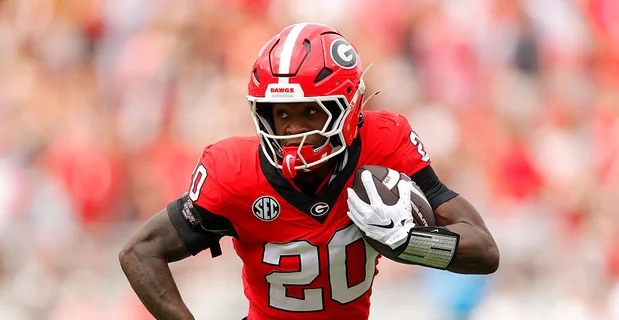
Now here’s a player who really has my attention.
Georgia running back Dwight Phillips Jr. is an explosive athlete with the kind of acceleration that immediately jumps off the screen.
And while we’re looking ahead to the 2028 NFL Draft, I believe Phillips is already establishing himself as a prospect worth following closely.
Phillips has legitimate track speed, having recorded a 10.24-second 100-meter dash.
But I’ve said this many times during my years evaluating football players.
Track speed and football speed are two entirely different things.
I’ve seen plenty of outstanding track athletes who couldn’t translate that speed onto a football field.
Phillips appears to possess something more.
He has the ability to accelerate through openings, reach top speed quickly, and threaten a defense every time he touches the football.
What particularly interests me from a biomechanics standpoint is his acceleration mechanics and ability to maintain momentum while changing direction.
Those are traits I want to study more closely.
His 120-yard rushing performance against Alabama certainly added to his growing reputation.
He’s still developing as a complete running back, particularly in areas such as pass protection and recognition.
But the physical tools are undeniable.
MY TAKE: Phillips has the potential to become one of the more intriguing running back prospects in the 2028 class. His combination of acceleration, explosiveness, and open-field ability makes him a player I’ll be watching closely over the next two seasons.
4. CADE ULUAVE | LB | BYU
STOCK: RISING
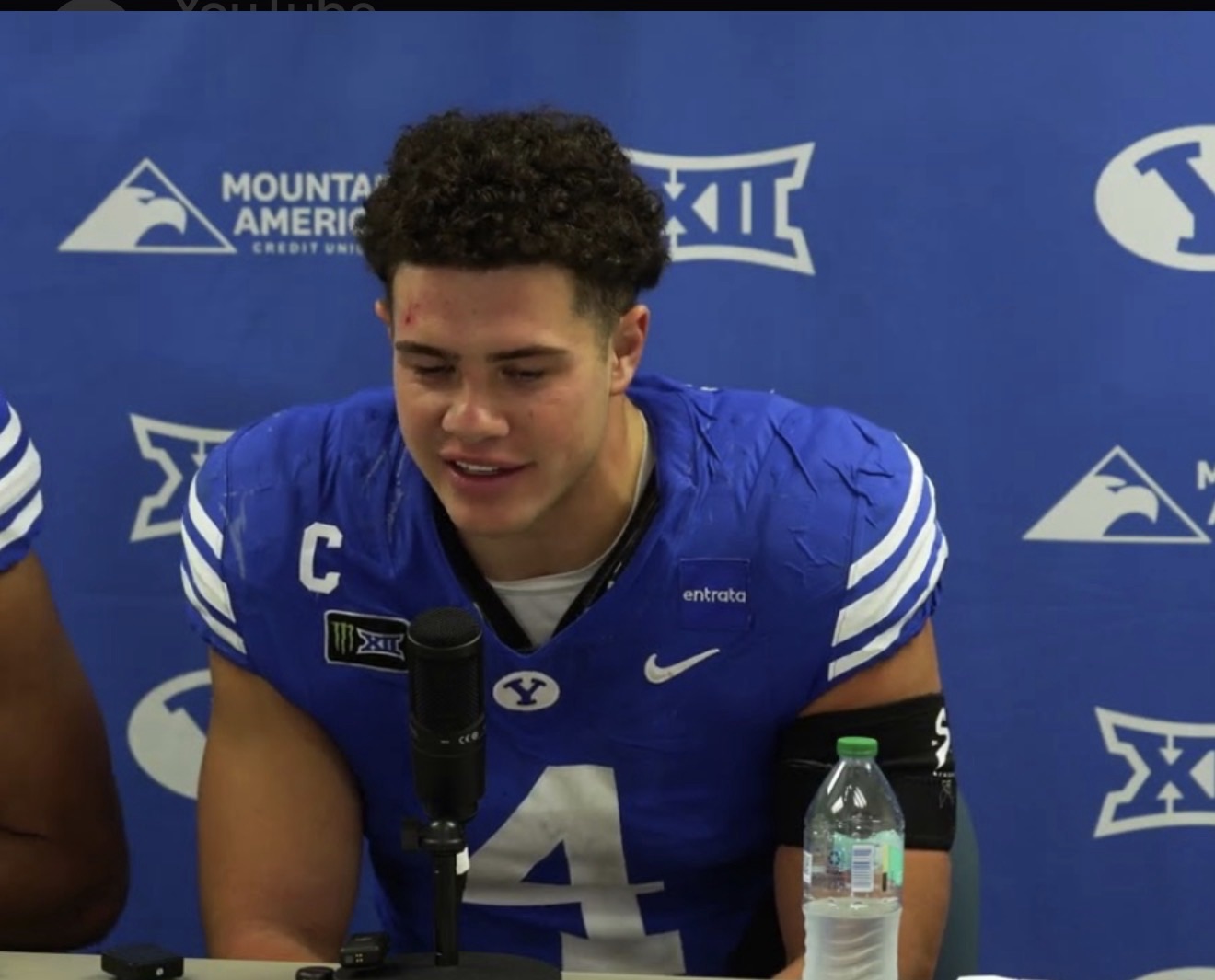
Here’s a linebacker who deserves more attention from NFL scouts.
Cade Uluave transferred to BYU after an impressive career at California, and he’s continuing to demonstrate the instincts and athletic ability that make him an intriguing prospect.
Against Notre Dame, Uluave recorded nine tackles and helped BYU pull off a 28-24 upset.
Now, when I evaluate linebackers, I’m not particularly interested in simply counting tackles.
I want to know how those tackles happened.
Did the linebacker diagnose the play before the offensive linemen reached the second level?
Did he recognize the blocking scheme?
Did he take the proper pursuit angle?
And perhaps most importantly, did he anticipate the play or simply react to it?
Those are the questions that determine whether a linebacker has NFL potential.
Uluave has demonstrated promising instincts and the ability to pursue the football.
At approximately 6-foot-1 and 230 pounds, he’s not an exceptionally large linebacker.
But today’s NFL places considerable emphasis on linebackers who can move in space and recognize offensive concepts.
I still want to study his coverage responsibilities and his ability to disengage from blockers.
MY TAKE: Uluave is moving up my linebacker watch list. I see an instinctive player with the potential to contribute at the next level, particularly if his coverage ability continues to develop.
📉 STOCK FALLING
5. ARCH MANNING | QB | TEXAS
STOCK: FALLING
I’m going to say something that probably won’t sit well with some Texas fans.
I believe Arch Manning has been one of the most overhyped quarterback prospects in recent college football history.
And I’ve felt that way since he was coming out of high school.
The Manning name certainly carries considerable weight in football circles.
But a famous last name doesn’t complete passes, recognize blitzes, or read defensive coverages.
Against Florida on Saturday, Manning completed 14 of 20 passes for 173 yards and one touchdown in Texas’ 27-24 loss.
Those numbers aren’t necessarily terrible.
But they don’t tell the entire story.
Texas has now suffered consecutive losses, and Manning continues to demonstrate inconsistencies that concern me when projecting him to the NFL.
I see a quarterback with adequate physical tools and some impressive athletic ability.
But I also see a player who has yet to consistently demonstrate the command, anticipation, and processing ability that I expect from an elite NFL quarterback prospect.
I’ve said this before.
There’s a difference between being a talented quarterback and being an elite quarterback prospect.
And right now, I don’t see enough evidence to place Manning in that elite category.
Can he improve?
Absolutely.
But I’m evaluating what I see on film, not what his last name suggests he should become.
MY TAKE: Manning’s draft stock is slipping in my evaluation. He still has NFL potential, but I believe the expectations surrounding him have exceeded his actual development. I need to see more consistency, better anticipation, and stronger command of the offense before considering him a first-round quarterback.
6. JULIAN SAYIN | QB | OHIO STATE
STOCK: FALLING
Julian Sayin is another quarterback whose recent performance has raised some concerns.
Against Indiana, Sayin completed just 15 of 29 passes for 235 yards, two touchdowns, and two interceptions.
That’s a 51.7 percent completion rate.
Ohio State managed to escape with a 19-15 victory, but Sayin didn’t look like the same quarterback we’ve seen during some of his better performances.
And that’s important.
Sayin has demonstrated outstanding accuracy when operating within the structure of Ohio State’s offense.
But one of the biggest questions I have about him concerns how effectively he performs when that structure begins to break down.
What happens when his first read isn’t available?
What happens when the defense disguises its coverage?
What happens when pressure forces him to move off his initial throwing platform?
Those are the situations that interest me most.
I’ve always believed that quarterback evaluation should place considerable emphasis on how a player responds when things don’t go according to plan.
Almost any talented quarterback can look impressive when he’s standing in a clean pocket with open receivers.
The NFL demands considerably more.
Sayin also suffered an injury to his throwing arm late in Saturday’s game, which reportedly will sideline him for several weeks.
I want to make something clear.
An injury doesn’t make someone a lesser quarterback prospect.
My concerns are based on the inconsistencies in his performance, not the injury itself.
MY TAKE: Sayin remains a talented quarterback with NFL potential. However, his performance against Indiana exposed some areas that deserve closer examination. I want to see better decision-making and more consistent execution when he’s forced outside the structure of the offense.
Here’s something I want people to understand about these stock reports.
I’m not declaring that Sam Leavitt is suddenly an elite quarterback because he played well against Mississippi State.
I’m not suggesting Drew Mestemaker is guaranteed to become an NFL starter.
And I’m certainly not saying that Arch Manning or Julian Sayin can’t develop into outstanding professional quarterbacks.
What I’m doing is evaluating their development.
NFL scouting is about projection, not popularity.
A player’s recruiting ranking doesn’t determine his NFL future.
Neither does his last name.
And neither does the amount of money he’s receiving through NIL.
I’ve evaluated thousands of football players over the years, and some of the biggest mistakes I’ve seen come from scouts who fall in love with physical measurements and overlook the mental components of the game.
That’s particularly true at quarterback.
Arm strength matters.
Accuracy matters.
Athletic ability matters.
But the ability to process information, anticipate defensive movement, and make sound decisions under pressure is what separates the good quarterbacks from the great ones.
That’s why I’m not rushing to release my NFL Draft Big Board.
My first Big Board won’t be published until January 1.
I want to see these players finish their seasons.
I want to evaluate how they respond to adversity.
I want to see whether they’re improving or simply benefiting from the talent surrounding them.
And I want to see how their physical tools and mental abilities project to the professional game.
Because ultimately, that’s what scouting is supposed to be about.
It’s not about being first with a ranking.
It’s about being right with the evaluation.