

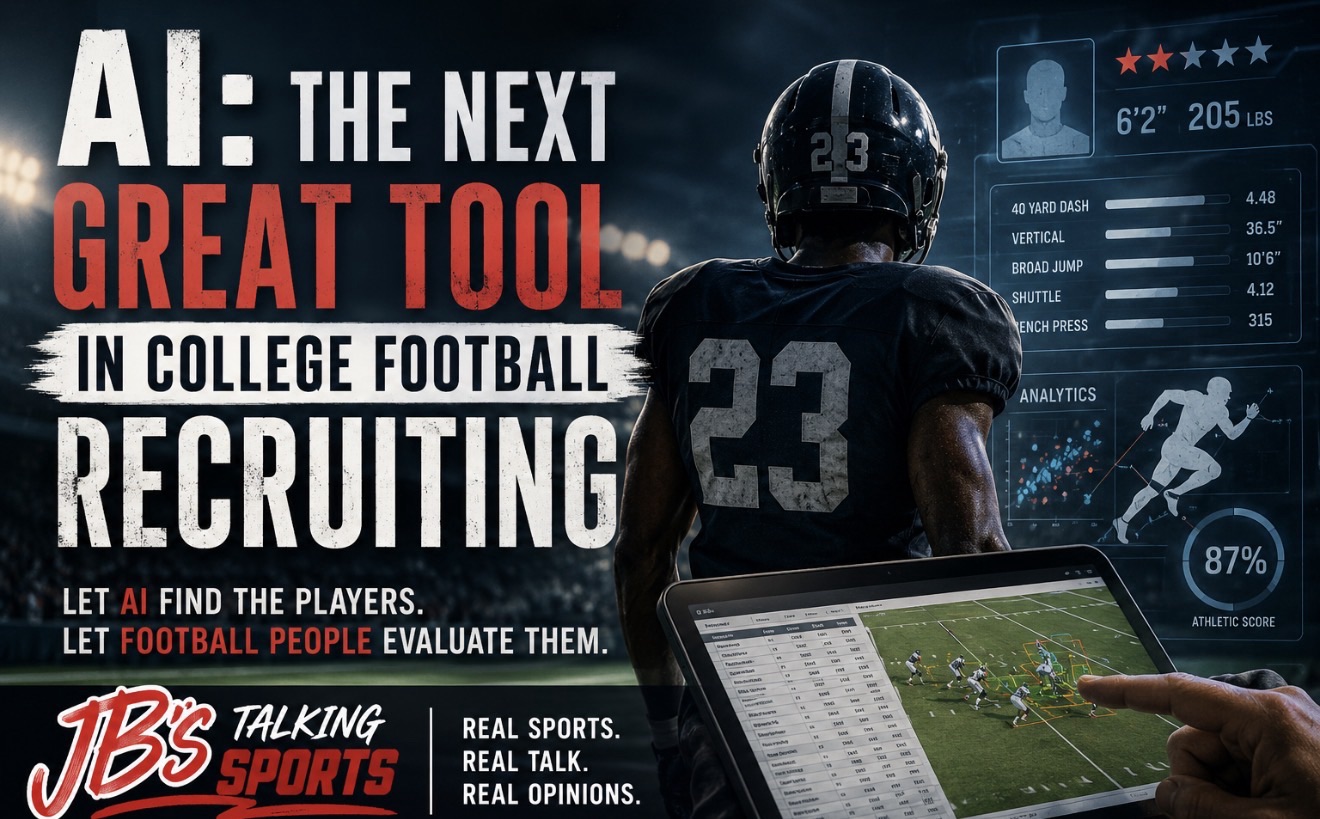
I recently heard Lane Kiffin talking about the potential of using artificial intelligence to evaluate football players, and immediately I thought: Why in the hell aren’t we already doing more of this?
The more I thought about it, the more I realized this really isn’t that different from something I was doing years ago.
When I was running football combines, I collected data on players and put it into an Excel spreadsheet. Height, weight, forty time, shuttle, vertical, broad jump and other measurements went into the database. I could manipulate that data, compare athletes and look for certain combinations of size and athletic ability.
It wasn’t artificial intelligence.
It was Microsoft Excel.
But the basic idea wasn’t all that different.
I was using a computer to take raw information about football players and help me identify things that might not immediately jump off the page.
Now imagine what artificial intelligence could do with that same concept.
Instead of evaluating a few hundred players at a combine, AI could potentially analyze thousands upon thousands of football players. And we’re not talking about just forty times and vertical jumps anymore.
We’re talking about game film.
Movement.
Acceleration.
Change of direction.
Production.
Size.
Strength.
Competition level.
Position-specific traits.
And probably hundreds of other variables that a human evaluator simply doesn’t have enough hours in the day to analyze across thousands of players.
That doesn’t mean I want AI deciding who gets a scholarship.
Not at all.
Football is still a human game.
There are things you can’t put into an algorithm very easily. What’s inside that kid’s chest? How competitive is he? Does he love football? Can he take coaching? What happens when he gets knocked on his ass three plays in a row? What happens when he’s sitting third on the depth chart and hasn’t played in three weeks?
Those things still require coaches and scouts.
But here’s where I think AI could completely change recruiting.
Let AI find the players. Let football people evaluate them.
Think about how recruiting works.
There may be a kid playing at some small high school who doesn’t have four stars beside his name. Maybe he hasn’t been to all the camps. Maybe he doesn’t have a recruiting service pushing his name. Maybe he’s playing somewhere that doesn’t get much attention.
But the kid can play.
AI doesn’t have to care how many stars he has.
It doesn’t have to care who has offered him.
It doesn’t have to care whether Alabama, Georgia or Ohio State is recruiting him.
The computer can simply look at the information and say:
You might want to take a look at this kid.
And that could be revolutionary.
There’s another part of this that fascinates me.
Every football program is looking for something slightly different.
If I’m running an Air Raid offense, I’m probably looking for different traits in a quarterback than somebody running a heavy option offense.
If I’m a defensive coordinator who wants long, physical cornerbacks who can play press coverage, I should eventually be able to tell an AI system exactly what I’m looking for.
Give me every cornerback in America who is at least 6-foot-1, has a certain level of speed and acceleration, demonstrates certain movement characteristics on film and meets whatever production numbers I’ve established.
Instead of my recruiting department searching through 5,000 players trying to find those kids, the computer gives me 50.
Now my scouts go to work.
That’s not replacing scouting.
That’s making scouting more efficient.
And with the transfer portal, this becomes even more interesting because now you’re dealing with players who already have college film.
A program could theoretically develop its own profile based upon players who have been successful in its system.
You could ask:
What characteristics did our best offensive linemen have?
What did our successful linebackers have in common?
What characteristics separated the quarterbacks who succeeded in our offense from the ones who didn’t?
Then you could search the portal for players displaying similar characteristics.
That’s where AI could become incredibly powerful.
And I know the argument against it.
People will say, “You can’t evaluate a football player with a computer.”
They’re right.
You can’t completely evaluate one with a stopwatch either.
But we’ve been using stopwatches for a hundred years.
We’ve used forty times, vertical jumps, bench presses, shuttle runs, recruiting rankings and statistics forever.
AI is simply another tool.
A much more powerful one.
There will also be mistakes. There will be bad data. There will be algorithms that place too much importance on certain measurements. There will still be five-star busts and two-star kids who become All-Americans.
That’s football.
But here’s the part I think people are missing.
The future of football scouting isn’t going to be AI replacing scouts.
It’s going to be scouts using AI.
And eventually I believe the programs that figure out how to use it best are going to have an enormous advantage over the programs that don’t.
In a strange way, it takes me back to those football combines and that Excel spreadsheet.
I was trying to answer a pretty simple question:
What does the data tell me about this football player that my eyes might have missed?
Artificial intelligence is asking the same question.
It just has a hell of a lot more data to work with.
— JB’s Talking Sports