
INDIANA’S DYNAMIC DUO: TWO RECEIVERS, TWO FIRST-ROUND TALENTS
Charlie Becker and Nick Marsh Could Give the Hoosiers Two First-Round NFL Draft Picks at Wide Receiver
By James Baxter | JB Talking Sportz
There are some pretty impressive wide receivers playing college football this season. Ohio State’s Jeremiah Smith is probably the first name that comes to mind, and deservedly so. But if you’re looking for the best combination of two NFL-caliber receivers on the same team, you might want to turn your attention toward Bloomington, Indiana.
Because I believe the Hoosiers have something special in Charlie Becker and Nick Marsh.
And I’ll go a step further. I believe both have legitimate first-round potential in the 2027 NFL Draft.
That’s not something I say lightly.
I’ve spent enough years evaluating football players to understand that college production doesn’t necessarily translate into professional success. There are certain physical characteristics, athletic traits and technical abilities that separate good college receivers from legitimate NFL prospects.
Both of these young men possess those characteristics.
And what makes this tandem particularly interesting is that they’re not carbon copies of one another.
They attack defenses differently, and that’s precisely what makes them so dangerous.
CHARLIE BECKER: THE COMPLETE PACKAGE
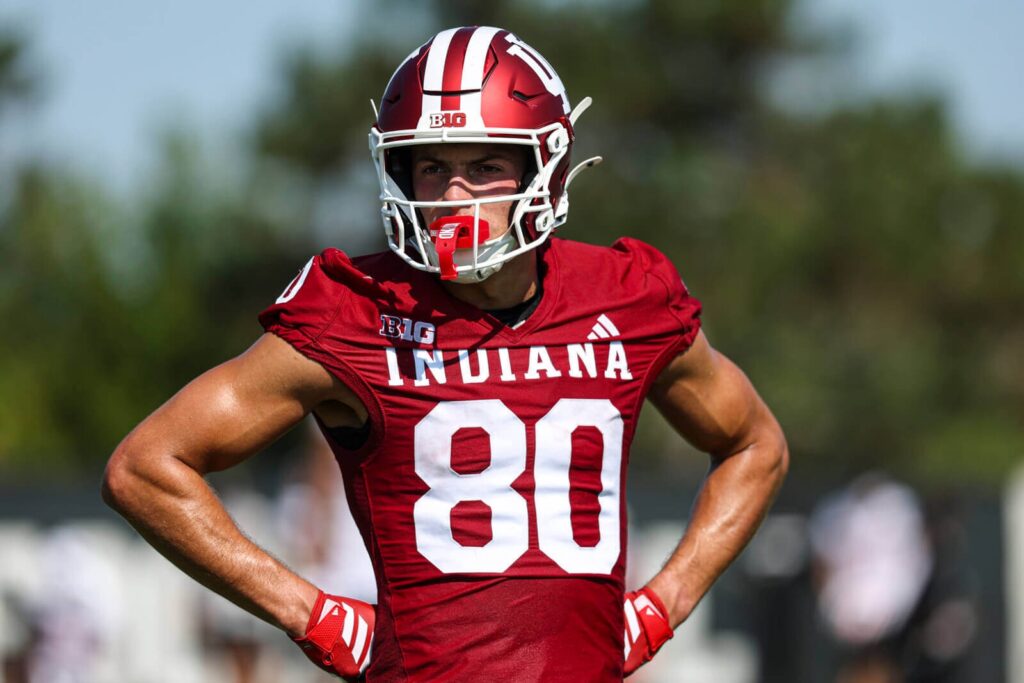
At 6-foot-4 and approximately 207 pounds, Becker possesses the kind of physical dimensions NFL scouts covet in an outside receiver.
But size alone doesn’t make someone a first-round prospect.
What impresses me about Becker is his ability to combine that size with legitimate downfield playmaking ability.
He isn’t simply a big receiver who wins jump balls. He can stretch the field, track the football over his shoulder and make difficult catches without breaking stride.
Those are important distinctions.
A lot of college receivers can run fast. Far fewer can maintain their speed while locating and adjusting to a football traveling 40 yards downfield.
Becker has demonstrated that ability repeatedly.
During Indiana’s national championship season in 2025, Becker caught 34 passes for 679 yards and four touchdowns, averaging nearly 20 yards per reception.
That’s an extraordinary average for a receiver his size.
And remember, he wasn’t even the primary receiving option for much of that season.
When injuries created an opportunity, Becker took advantage of it.
This season, he’s taken another step forward.
Through nine games, Becker has 50 receptions for 875 yards and nine touchdowns. He’s averaging 17.5 yards per catch while producing nearly 100 receiving yards per game.
Those aren’t simply good numbers. They’re the kind of numbers that demand attention from NFL personnel departments.
Consider his performance against Ohio State, when he caught nine passes for 165 yards. Or his eight receptions for 149 yards against Minnesota this weekend.
When you’re producing against Big Ten defenses with NFL-caliber defensive backs, the evaluation becomes considerably more meaningful.
From a scouting standpoint, Becker checks several important boxes.
He has the length to create favorable matchups, the body control to adjust to poorly placed throws and the ball skills to finish contested catches.
I particularly like receivers who understand how to position their bodies between the defender and the football.
Becker demonstrates that ability.
My biggest question isn’t whether he can play in the NFL.
It’s how high his ceiling might be.
My projection: First round, with legitimate top-15 potential.
NICK MARSH: A DIFFERENT KIND OF PROBLEM
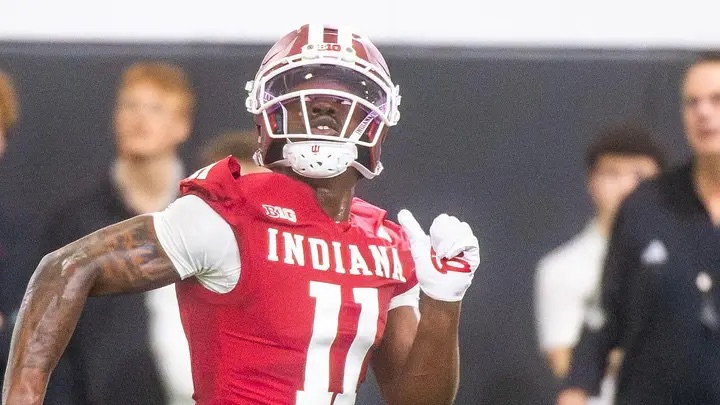
If Becker is the polished downfield weapon, Nick Marsh is the physical nightmare waiting on the opposite side of the formation.
At 6-foot-3 and approximately 213 pounds, Marsh brings a different dimension to Indiana’s passing attack.
He’s a powerful receiver who doesn’t necessarily need five yards of separation to make a play.
He can use his body to shield defenders, attack the football in traffic and turn an ordinary reception into an explosive gain.
And here’s something I particularly like about Marsh.
He doesn’t become a spectator after catching the football.
He’s dangerous after the catch.
That’s an increasingly important quality in today’s NFL, where offensive coordinators are constantly looking for receivers who can turn quick throws into substantial gains.
Marsh transferred to Indiana after two productive seasons at Michigan State.
In 2025, he caught 59 passes for 662 yards and six touchdowns despite playing in an offense that didn’t always provide ideal circumstances for a receiver to showcase his abilities.
The talent was there.
The opportunity to maximize it wasn’t always there.
Indiana changed that.
Through nine games this season, Marsh has 38 receptions for 669 yards and eight touchdowns, averaging an impressive 17.6 yards per reception.
His performance against Nebraska was particularly revealing.
Marsh caught six passes for 187 yards and two touchdowns, helping Indiana overcome an 11-point fourth-quarter deficit.
One touchdown covered 75 yards. Another went for 44.
That’s the kind of performance that gets the attention of NFL scouts.
And it demonstrated something important about Marsh’s game.
He’s not merely a possession receiver who uses his size to move the chains.
He has explosive-play potential.
In fact, Marsh generated 107 yards after the catch against Nebraska alone.
Think about that for a moment.
More than half his receiving yardage came after he secured the football.
That’s a remarkable demonstration of what he can do with the ball in his hands.
Marsh still has areas where he can improve, particularly in refining the technical aspects of his route running and consistently creating separation against tight man coverage.
But those are coachable skills.
You cannot coach his combination of size, strength and natural athletic ability.
My projection: First round, potentially somewhere between picks 15 and 30.
THE PROBLEM FOR DEFENSIVE COORDINATORS
Here’s where things get interesting.
Imagine preparing to defend Indiana’s passing attack.
You have Becker on one side of the formation and Marsh on the other.
Which one gets your best cornerback?
Which one gets safety help?
And what happens when Indiana begins moving them around the formation?
That’s a difficult problem to solve.
If you roll coverage toward Becker to eliminate the vertical passing game, Marsh becomes a dangerous option against isolated coverage.
If you concentrate on Marsh, Becker can punish you over the top.
And if you attempt to protect both sidelines with additional coverage, you’re creating opportunities elsewhere in the offense.
That’s the beauty of having two receivers with legitimate NFL ability.
They make each other better simply by being on the field together.
But there’s another factor I think deserves consideration.
Both players are operating in an offensive system that asks them to do more than simply run downfield and catch footballs.
They’re learning route concepts, coverage recognition, timing and the responsibilities that come with playing receiver at a high level.
Those are things NFL scouts evaluate carefully.
HOW DO THEY COMPARE TO THE REST OF THE 2027 CLASS?
Jeremiah Smith remains my top wide receiver prospect in this draft class.
His combination of physical talent and production puts him in a category very few receivers can reach.
Texas receiver Cam Coleman is another player with exceptional first-round potential.
But after those names, I believe Becker and Marsh deserve serious consideration among the best receivers available.
Becker would currently rank ahead of Marsh on my board because of his combination of size, downfield production and demonstrated ability to consistently threaten defenses vertically.
Marsh isn’t far behind.
In fact, depending on the offensive system and what a particular NFL team needs, I could understand a franchise preferring Marsh.
That’s what makes evaluating receivers so interesting.
The best receiver for one team isn’t necessarily the best receiver for another.
Some offenses need a vertical threat who can consistently stretch coverage.
Others need a powerful receiver who can work through contact, move the chains and create yards after the catch.
Indiana has both.
JB’S FINAL TAKE
I’ve always believed the most important part of evaluating a football player is determining whether his abilities will translate to the next level.
College statistics are useful, but they don’t tell the entire story.
You have to evaluate movement, acceleration, body control, physicality, spatial awareness and how a player reacts when the situation becomes difficult.
You also have to consider whether he’s winning because of superior athletic ability or because he possesses the technical skills necessary to succeed against equally talented opponents.
That’s where Becker and Marsh intrigue me.
Both have NFL size.
Both have demonstrated big-play ability.
Both have produced against quality competition.
And both possess physical characteristics that should translate well to professional football.
Will they both be selected in the first round?
There are still games to be played, evaluations to complete and NFL Combine performances that could change their draft positions.
But based on what I’ve seen, I wouldn’t be surprised if Indiana sends two wide receivers to the podium on the opening night of the 2027 NFL Draft.
And if I were running an NFL scouting department, I’d already have both names circled on my draft board.
JB Talking Sportz | College Football Analysis & NFL Draft Scouting